 AsobiSpace
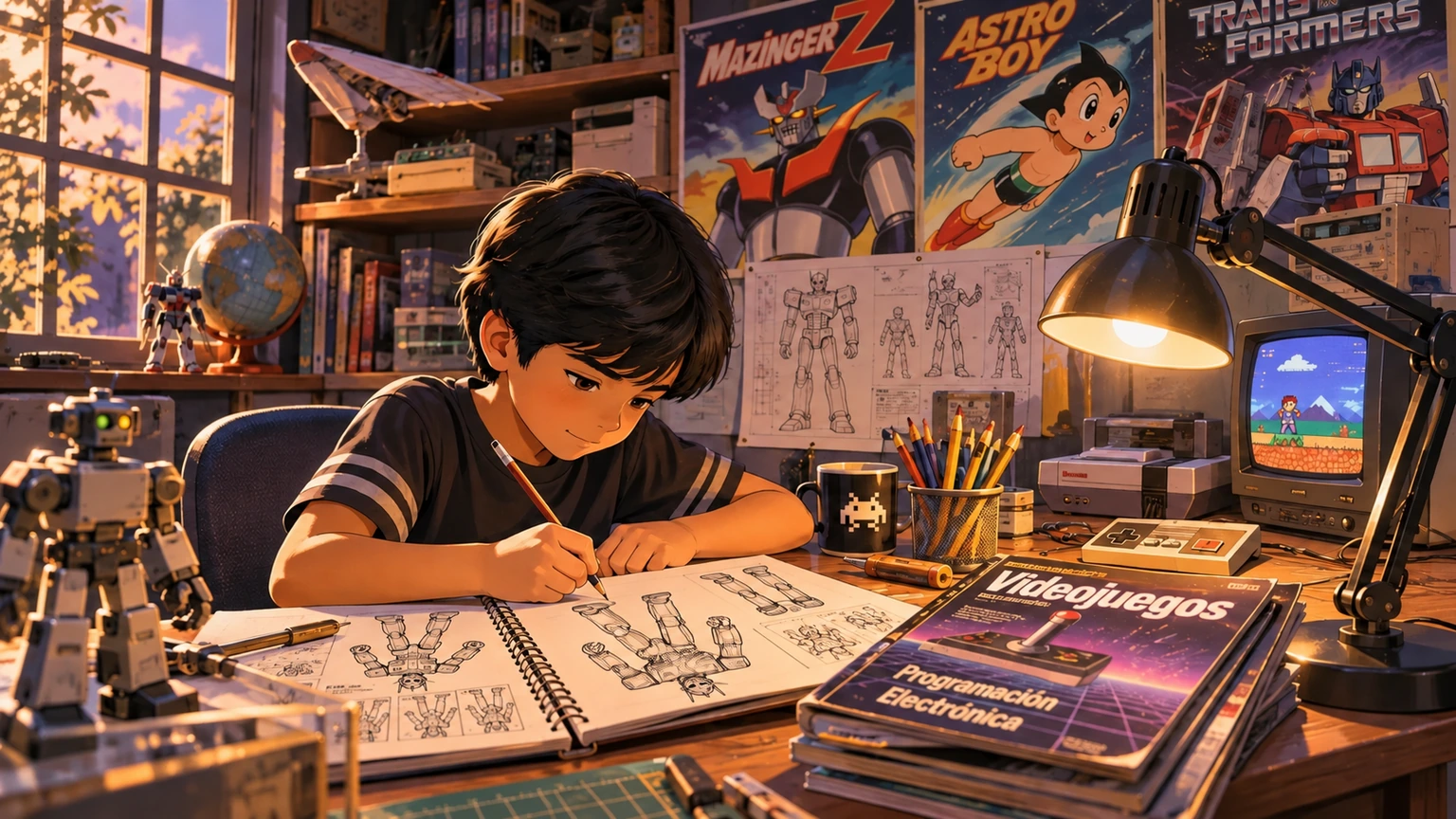
The boy who dreamed of robots
As a child, I could spend hours imagining how the extraordinary machines I saw in series such as Mazinger Z, Astro Boy, and Transformers worked.
There was something fascinating about those robots. It was not only their appearance or what they could do, but the thought that one day it might be possible to build machines capable of moving, making decisions, and acting on their own.
My curiosity did not remain in front of a screen. I also enjoyed exploring gardens, observing plants, and discovering the enormous variety of insects I found there. In both technology and nature, I was drawn to the feeling that there was always something more to discover.
Years later, programming let me experiment with some of those ideas. In my first encounters with video game development, concepts such as pathfinding, state machines, and decision systems helped me create small behavior logics. A character could patrol, detect conditions, pursue a target, or change its behavior—all through rules I had to define.
Those rules could produce behavior that seemed autonomous. Although I did not connect it with machine learning then, today I see a link between those experiences and what I discovered later.
What would happen if, instead of programming every behavior, we could build systems capable of learning?
That question marks one of the most interesting differences between traditional programming and many techniques used in AI. But before exploring how machines learn, it is worth understanding where the idea came from. Its roots are much older than we might imagine.
Before artificial intelligence existed
Today we may think of virtual assistants, robots, image generators, or conversational models. But imagine an era before modern computers. How could we build something that imitated human abilities?
For centuries, inventors created automata: mechanisms that mimicked animals, wrote, played instruments, or performed small actions. However extraordinary they appeared, they did not understand what they were doing. Their behavior was determined by how they had been built.
Reproducing an action does not necessarily mean understanding it. Before machines could reason, adapt, or learn, people needed ways to represent problems and procedures through logic and mathematics.
Ideas that prepared the way
The possibilities of machines
Lovelace’s notes on Charles Babbage’s Analytical Engine explored how a machine might operate on symbols by following rules—a vision beyond numerical calculation.
Mathematical logic
Boole developed algebraic tools for representing logical operations, ideas that would become fundamental to digital computing.
The universal machine
Turing presented a theoretical model for studying which procedures could be performed through computation, helping establish the foundations of modern computing.
These thinkers explored possibilities that the technology of their time could not yet realize. When computers began to develop, an even more ambitious question emerged: how far could their abilities go?
Can machines think?
What does it really mean for a machine to be intelligent?
A computer may solve a problem, recognize an object, or maintain a conversation. We can observe the result, but does it understand what it is doing—or execute procedures that produce answers we interpret as intelligent?
Inspiration from the brain
Warren McCulloch and Walter Pitts proposed a simplified mathematical model of artificial neurons: connected units that could process signals and perform logical operations.
The imitation game
In Computing Machinery and Intelligence, Turing addressed “Can machines think?” through an experiment based on written questions and answers, avoiding the need for an exact definition of thought.
So what is the Turing test?
Imagine exchanging written messages with someone you cannot see. You do not know whether a person or a computer is on the other side. Would you be able to tell them apart?
The experiment was not intended to prove that a computer was conscious. It explored whether a machine could display conversational behavior difficult to distinguish from a human’s. That distinction remains relevant: observing an impressive result is not the same as understanding the process or its limitations.
When artificial intelligence was given its name
Machines executing instructions, mathematical neurons, and questions about intelligent behavior still needed to come together as a systematic field of study.
AI becomes a discipline
John McCarthy, Marvin Minsky, Nathaniel Rochester, and Claude Shannon proposed a gathering devoted to machine intelligence. Their document used the term Artificial Intelligence. The 1956 meeting at Dartmouth College became a foundational event for the research discipline.
They wanted to explore whether machines could use language, form concepts, solve problems, and improve. It was an ambitious vision when computing was still taking its first steps.
A program that proved theorems
Allen Newell, Herbert Simon, and Cliff Shaw developed one of the earliest AI programs, using computational procedures to prove mathematical theorems.
It showed that programs could approach some intellectual tasks. But how could a system handle situations we had not anticipated—and improve through experience?
What if machines could learn?
Imagine classifying fruit by size, weight, or color. We could keep writing rules for every variation, or try something different.
What if we showed the system examples and allowed it to adjust the way it makes decisions?
Instead of defining every answer manually, data can help an algorithm find relationships. This does not mean a computer learns exactly as we do; it modifies parameters through information and training procedures.
The perceptron
Rosenblatt developed a neuron-inspired model that adjusted its parameters through examples to learn certain classifications.
The model assigns weights to numerical features, combines them, and produces an answer. During training, an incorrect answer leads to mathematical adjustments. Repeated examples can improve its ability to distinguish patterns without a specific answer being programmed for each fruit.

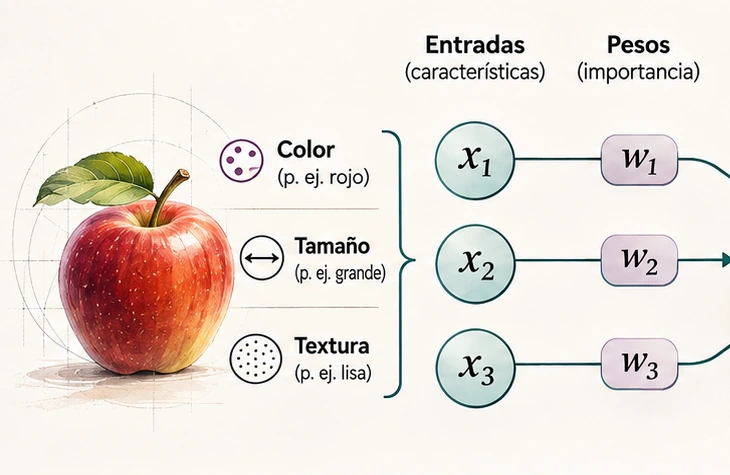
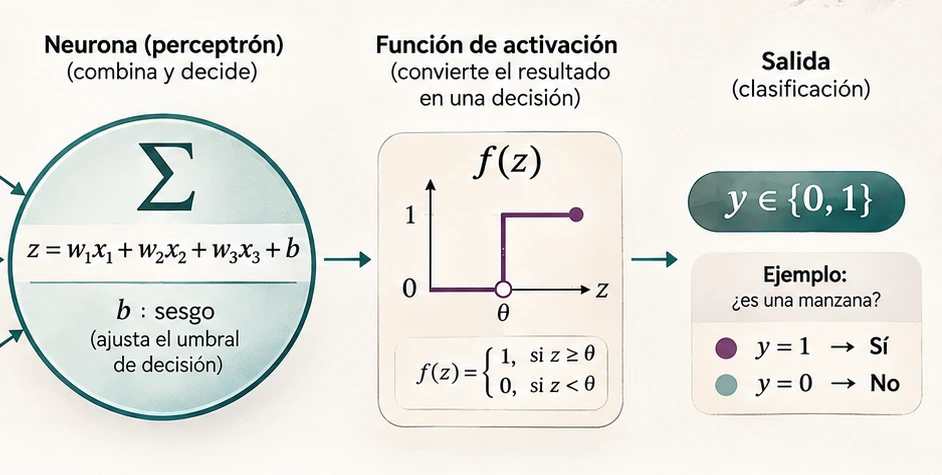
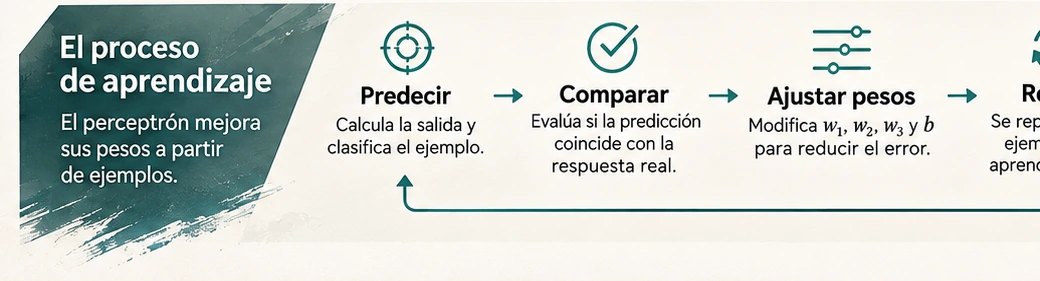
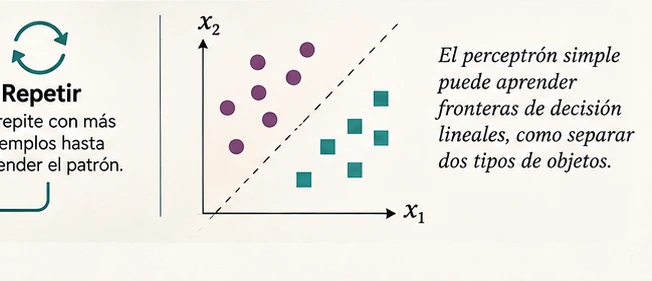
But a model’s ability to learn does not mean it can learn anything. The simple perceptron could solve only certain classifications, including groups separable by a linear boundary.
The perceptron’s limits
Perceptrons analyzed the capabilities and limitations of these networks, clarifying which problems they could solve and which required other approaches.
When rules seemed sufficient
Other researchers developed symbolic AI, representing knowledge through symbols, relationships, and explicit rules. Expert systems such as DENDRAL and MYCIN showed the potential of encoded specialist knowledge, but also how difficult those systems were to maintain and expand.
There was never only one way to approach AI. Learning from examples, symbolic knowledge, statistical methods, and other forms of problem solving evolved—sometimes separately, sometimes together.
When enthusiasm turned into winter
Possibilities often advance faster than our ability to realize them. Early AI successes inspired enormous expectations, but real-world problems required information and computing power that were not yet available.
Expectations cool
James Lighthill’s critical report on UK research contributed to reduced support amid unmet expectations and technical difficulties.
Interest returned with expert systems in the 1980s, but many were expensive, inflexible, and difficult to maintain. By the late 1980s and early 1990s, lost commercial confidence helped bring another reduction in investment—the second AI winter.
The AI winters did not mean all research stopped. Their effects differed across countries and fields. Researchers continued working on neural networks, machine learning, probabilistic models, and other approaches.
Sometimes an idea does not need to disappear simply because we cannot yet use it to its full potential.
It may need time, new tools, and people willing to keep exploring it. That was part of what happened with AI.
The ideas that never disappeared
Many ideas we associate with advanced technologies began when computers were taking their first steps. Behind today’s advances are generations of researchers who imagined possibilities, faced limitations, and pursued questions whose answers took decades.
This is not only a story of machines and algorithms. It is also one of curiosity, perseverance, and people who dared to imagine something they could not yet build.
When I learned animation and 3D modeling, I began seeing ordinary objects as geometry, polygons, and structure. Years later, studying AI changed my perspective again.
Around 2018, courses on Coursera and Udacity deepened my interest. Mathematics, statistics, and data acquired a new meaning: not merely formulas, but ways to discover patterns and imagine applications.
3D modeling
Geometry · polygons · structure
Seeing through data
Patterns · relationships · possibilities
I returned to linear algebra, calculus, and statistics. Understanding how they applied to something I cared about made the effort worthwhile, and every concept seemed to open another door.
This history matters not only because it explains where AI came from, but because every advance contains knowledge that other people built and shared. Knowledge gains value when it sparks new questions and inspires others to explore.
This series is not intended as an exhaustive history. I want to share the ideas I have discovered, the questions that have accompanied me, and the possibilities that awakened my curiosity—from science and education to medicine, creativity, and research.
Machines did not suddenly begin to learn. Systems capable of doing so had existed for decades. What changed was our ability to take those ideas much further.
What allowed models and algorithms that had been developing for so long to begin achieving extraordinary results?
That is the question we will explore in the next installment: When machines began to learn.
When machines began to learn →
From early algorithms to modern neural networks: data, experimentation, and the ideas that transformed the way we build AI.